

EVPN RT5 SR MPLS- L3VPN SRv6 Interworking
Many service providers are transitioning to SRv6 for its programmability and streamlined network operations, but MPLS remains extensively deployed. Interworking plays a crucial role in enabling a phased migration, allowing SRv6 and MPLS to coexist within the same network without requiring a complete infrastructure change.
In order for this to happen, gateways must be deployed between these domains. These gateways provide service interworking on the control and data planes:
They need to import service routes and re-advertise them for the control plane. For the data plane, they perform a pop/decap operation, followed by an IP lookup, and then proceed with a push/encap operation.
For this test, we verified that the gateways replaced the MPLS label with an SRv6 Service SID (End.DT4 with NEXT-CSID for IPv4, End.DT6 with NEXT-CSID for IPv6). Then, the prefix was advertised as a VPNv4/VPNv6 route in SRv6. In the reverse direction, the gateway converted SRv6 SIDs back to MPLS labels and rewrote the next-hop and label stack for correct forwarding in the SR-MPLS domain.
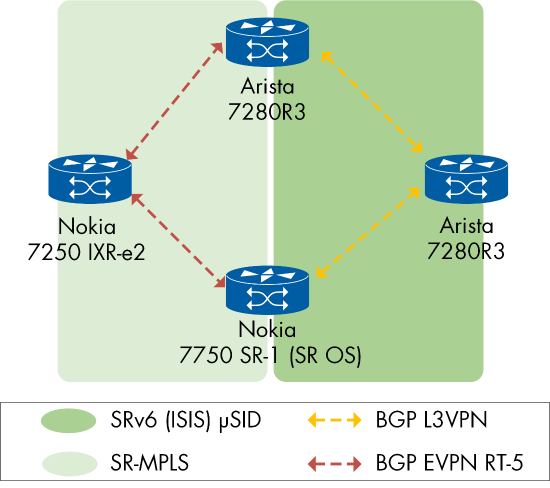
Figure 99: EVPN RT5 SR MPLS- L3VPN SRv6 Interworking
| PE | SRv-SRmpls GW | Traffic Generator |
|---|---|---|
Arista 7280R3, | Arista 7280R3, | Keysight IxNetwork |
Table 54: EVPN RT5 SR MPLS- L3VPN SRv6 Interworking - µSID
| < Previous | Next > |